Advanced AI for Healthcare

The Bridge Between
Patient and Practice.

Patients and practices want the same thing, and both lose hours to records that don’t fit together, messages that get lost and steps that never line up. Democura brings advanced AI systems into healthcare to close that gap: one record both sides can trust, one clear way to share it, and procedures that finally connect.

Where Care Gets Lost

Both Sides Feel It. Neither Side Caused It.

A patient fills out the same form for the fifth time. A front desk retypes a faxed referral. A clinician finishes the day’s notes after dinner, from memory. Everyone involved is doing their best, and the information still doesn’t travel.

Most of that friction comes from three places: records that were never built to fit together, no shared standard for how information moves between patient and practice, and procedures that have been nearly impossible to reconcile. That is the gap Democura is built to close, working with the practices people already trust.
How It Works

From Intake to Record.

Five steps, from the first form a patient fills out to the record they keep for life, and the same steps for the practice that cares for them.

01

Three Ways In, One Form.

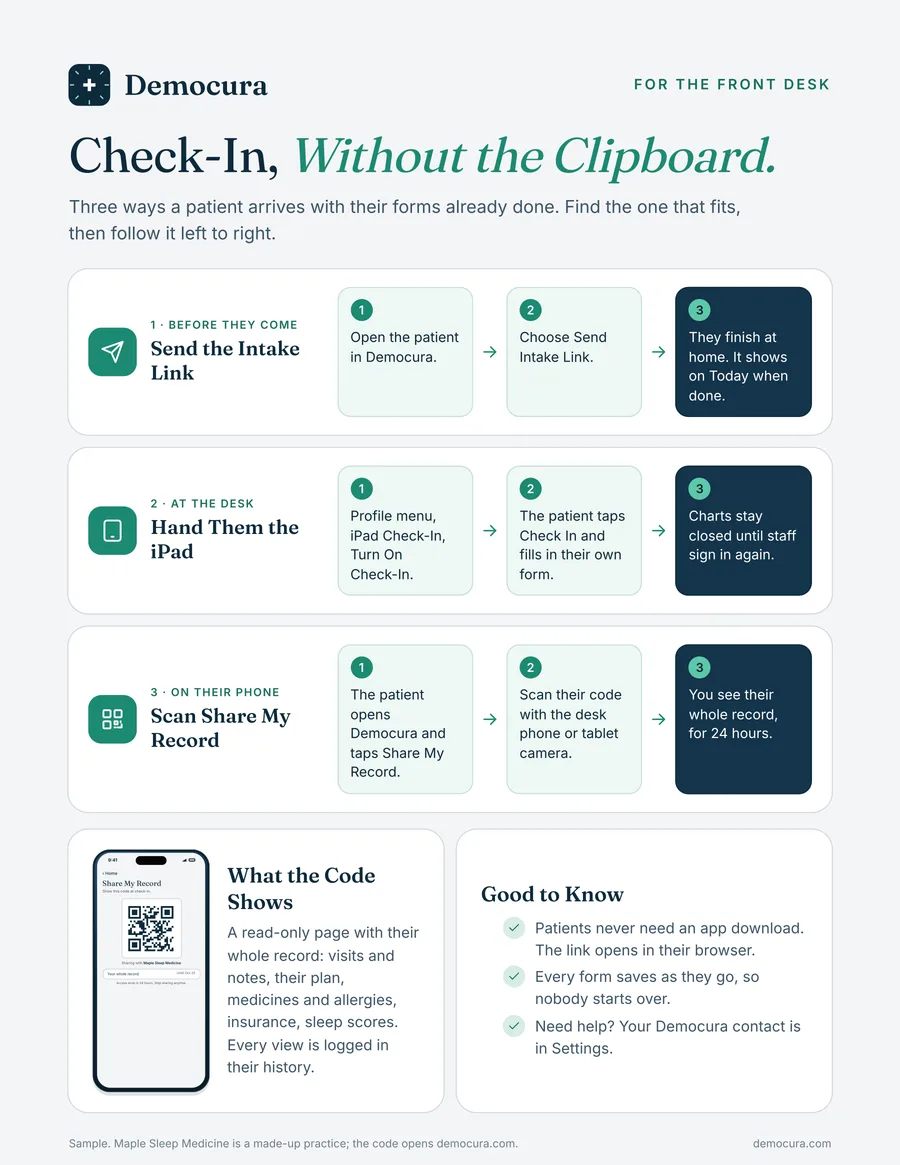
A patient fills out the online link before the visit or taps through it on the front desk iPad, and a faxed referral is read by the Reader into the very same form. However they come in, the practice gets one clean intake.

  • One Link, Any Device. Patients get a link by text or email and finish at home, one question per screen, with larger text or dictation when they want it. Every step saves, so they can stop and come back.
  • The Front Desk iPad. For walk-ins, or anyone who would rather do it in the office, the same intake runs on an iPad at check-in, locked to that one job.
  • Faxes, Read for You. Referrals still arrive by fax. The Reader reads each one, finds the patient and the reason, and puts it in the same queue as everything else.
02

Entered Once, Never Retyped.

The intake lands in the chart once: the patient, their consents, coverage, questionnaires and the referral itself. Nobody retypes a form, and the front desk starts the day with the work already done.

  • One Source of Truth. The chart is the practice’s record of the patient: facts, consents, coverage, questionnaires, documents and referrals, in one place.
  • Nothing Retyped. What the patient entered is what the staff sees. The day starts with forms to check, not forms to copy.
  • Every View Logged. Opening a chart is recorded, so the practice always knows who looked at what, and when.
03

Listened To, Written Up.

With the patient’s consent, the visit is listened to and the note writes itself, so the clinician looks at the patient instead of a screen and signs a draft instead of writing from memory after dinner.

  • Consent First. Nothing is listened to until the patient agrees, and they can always say no.
  • A Draft, Not a Decision. The note arrives as a draft. The clinician reads it, changes what needs changing and signs it; nothing unsigned reaches the chart.
  • Eyes on the Patient. Less typing in the room, and no notes finished after dinner from memory.
04

Promises, Flags and Trends.

The note is only the start. Democura keeps track of what the doctor promised, flags studies the patient may qualify for, shows whether things are getting better or worse, and books what comes next.

  • Promises Kept. When the doctor says “I will call you with the results,” it becomes a reminder on their list.
  • Research, Offered Fairly. A patient who may qualify for a study is flagged for the care team to mention. The patient decides, and nothing is shared without their yes.
  • Better or Worse. Answers and scores are compared visit to visit, so a change shows up early instead of at the next crisis.
05

Theirs, Shared on Clear Terms.

Everything ends in one record the patient owns. They decide who can open it and for how long, and both sides can see who opened what, and when.

  • Theirs to Keep. Visits, results, notes and plans in plain language, with the originals a tap away, to download or print any time.
  • Access They Grant and End. The whole record goes to the offices they choose, and access ends on its own or when they stop it, with a log of who saw what.
  • It Moves With Them. A new doctor gets the whole history before the first visit, so care starts with the full picture instead of a blank form.

And on paper, for the counter and the waiting room. Every practice gets these, with its own name and code.

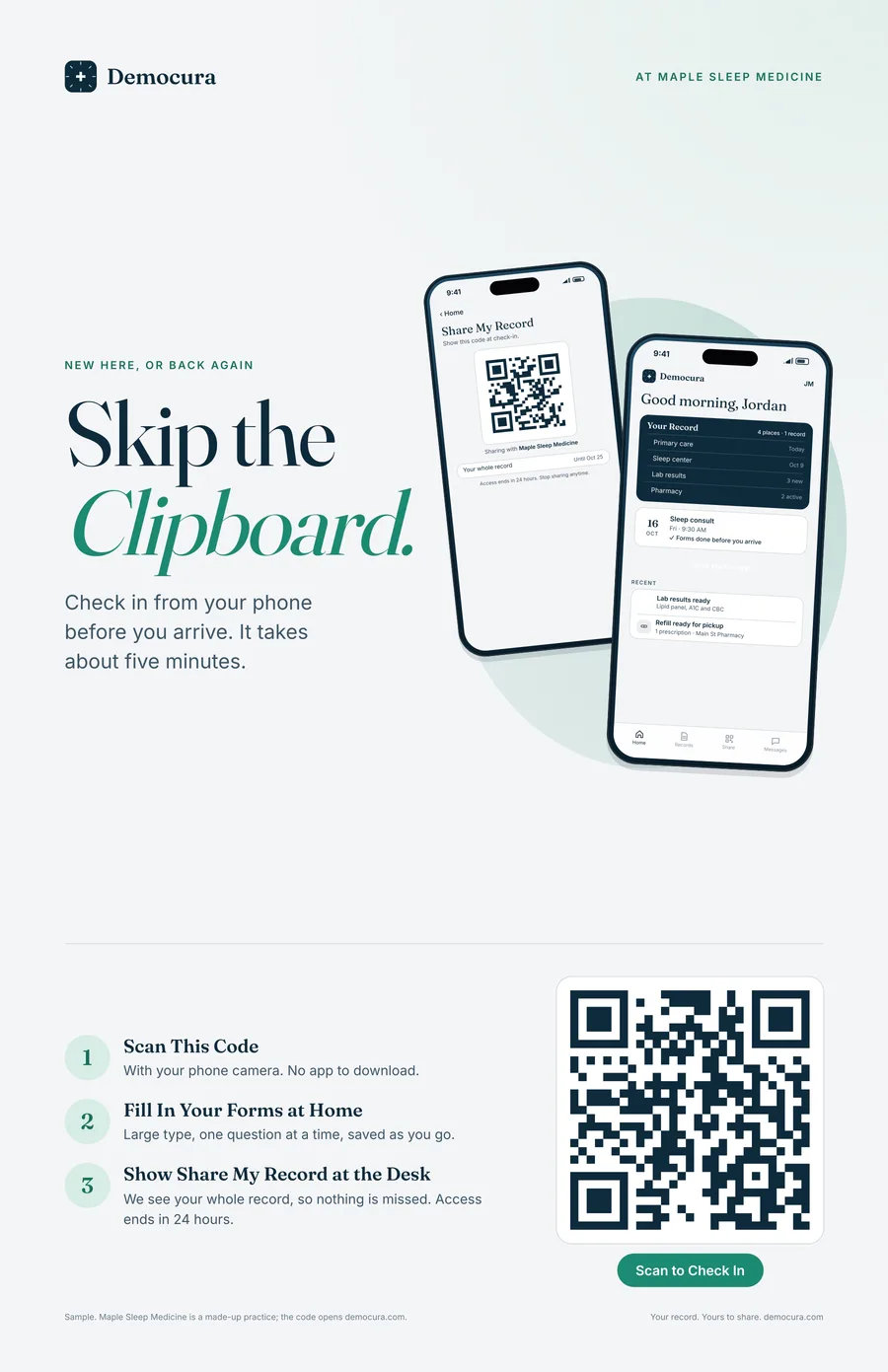
Counter poster: Skip the Clipboard. Check in from your phone before you arrive, with a code to scan.
Counter Poster 11 x 17 in
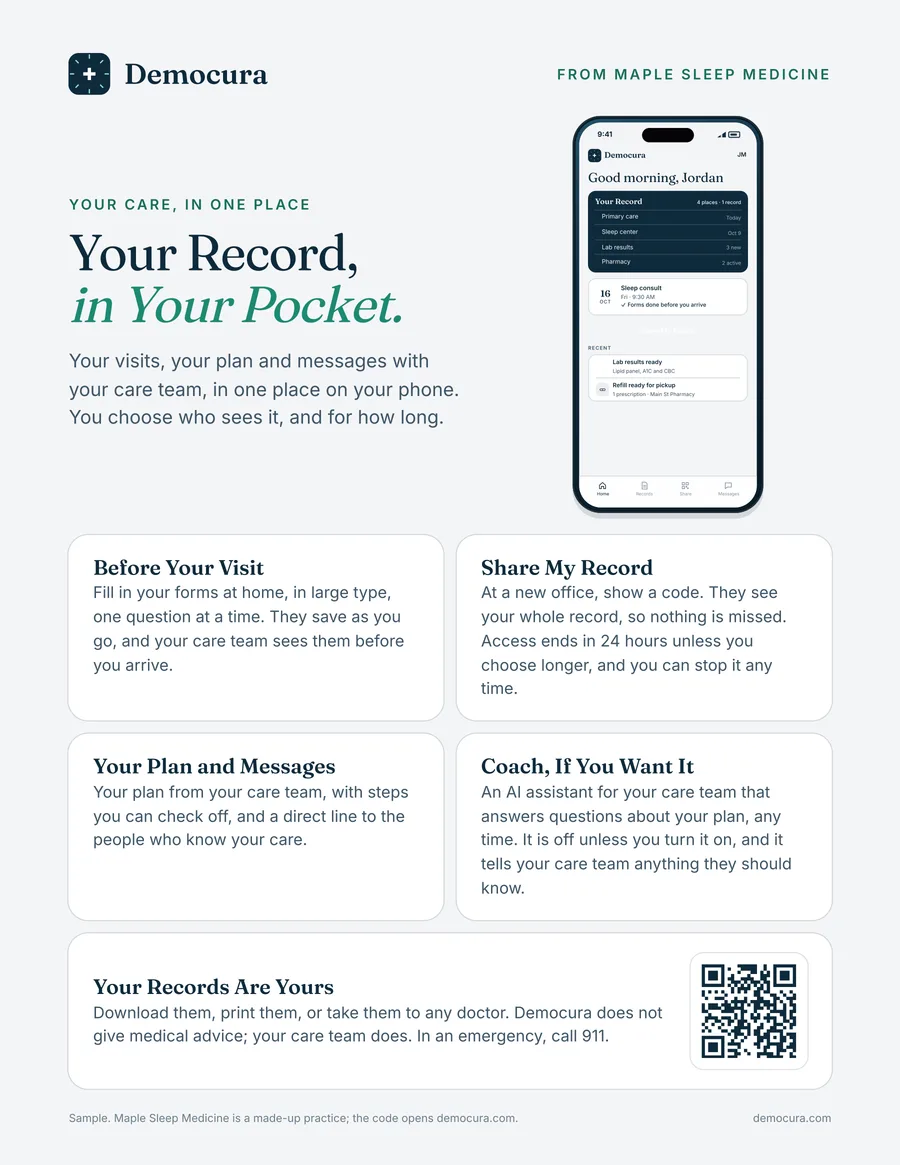
Patient handout: Your Record, in Your Pocket, with what the app does before, during and after a visit.
Patient Handout Letter
Front desk guide: Check-In, Without the Clipboard, the three ways a patient arrives with forms done.
Front Desk Guide Letter
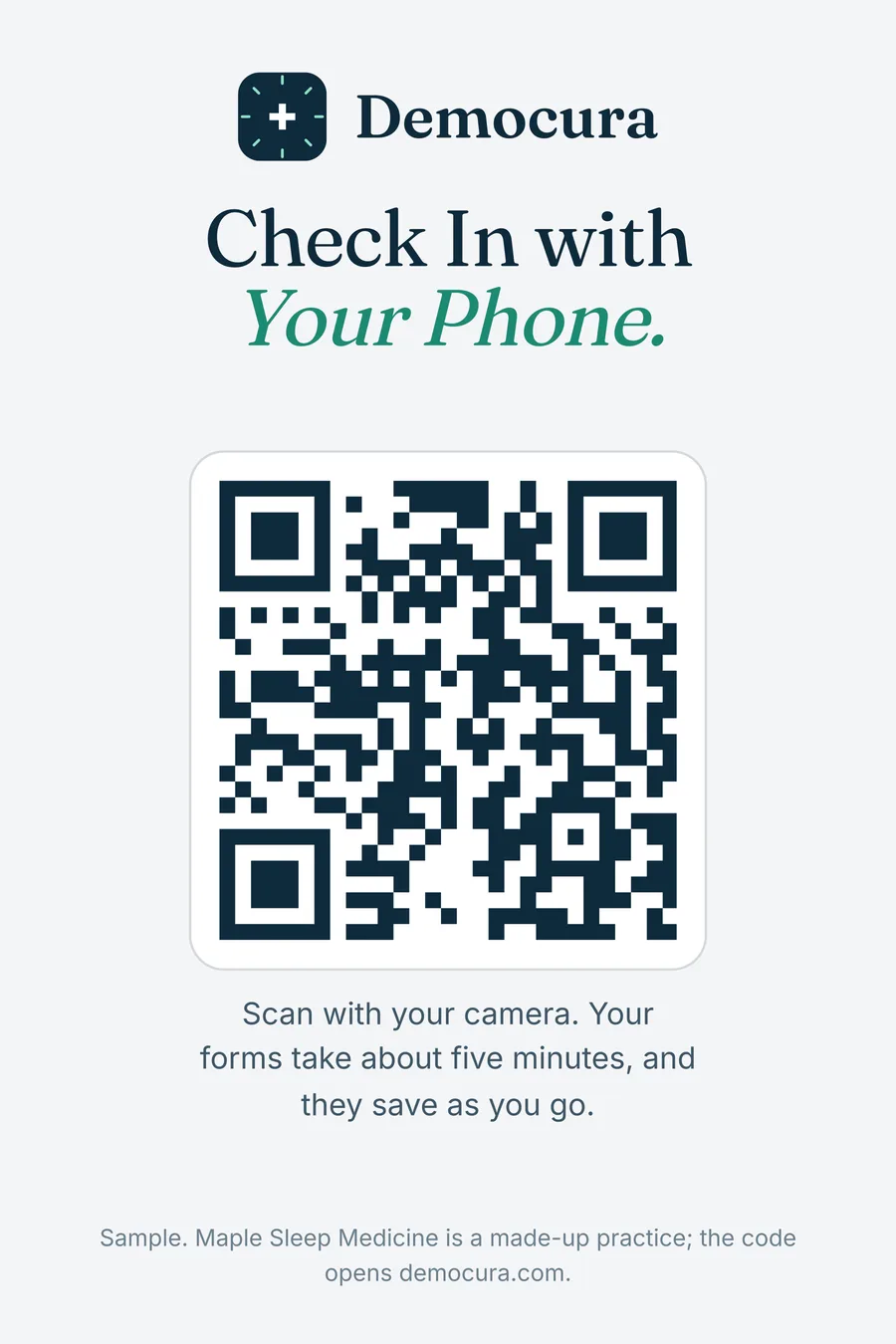
Counter tent card: Check In with Your Phone, with a large code to scan.
Tent Card 4 x 6 in

Samples. Maple Sleep Medicine is a fictional practice used for demonstration.

Who It Is For

Built for Both Sides of the Exam Table.

For Practices

A complete record arrives before the visit, forms already done, and AI tools take on the paperwork, so the team works with more efficiency and more trust.

For Practices

For Patients

One place for a whole health story, written to be understood, so every visit starts prepared, with dignity and peace of mind.

For Patients

For Families

Care for a parent or a child with their permission. See appointments, refills and results together, and hand the keys back whenever they want.

For Independent Practices

Advanced AI, Put to Work for Independent Practices.

Independent clinics and research sites do some of the most important work there is on systems that were never built to talk to each other. Democura integrates advanced AI systems into the practice and puts them to work on the problems every practice knows, alongside the systems you already run, so the work inside the practice moves with greater efficiency, greater trust and more peace of mind.

Referrals by FaxPackets read, sorted and checked for what is missing before anyone retypes a page. Meet the Reader.
The ClipboardOne intake link or the front desk iPad, one question per screen, and it lands in the chart once.
Visit NotesAn ambient scribe drafts the note from the visit, every sentence linked to what was said, for the clinician to sign.
Research MatchingEvery patient checked against each study's entry rules, with the reasons they may fit.

AI Models

The Best of All Worlds.

We build with every frontier model that exists, not just one lab's. Each agent we ship routes across all of them, choosing the right mind for the task at hand, including the popular models below.

Claude

Anthropic

Frontier reasoning and the agentic backbone.

ChatGPT

OpenAI

Generation, vision, and the broadest tool belt.

Gemini

Google

Long context and native multimodal reads.

Grok

xAI

Real-time knowledge with an edge.

Copilot

Microsoft

Pair programming across the whole stack.

Perplexity

Perplexity

Grounded answers, sources attached.

Mistral

Mistral AI

Fast, efficient, and open by design.

DeepSeek

DeepSeek

Open-weight reasoning at the frontier.

Qwen

Alibaba

Multilingual strength, openly released.

Partners

Practices, Research Sites and Firms

Practices, research sites and firms that put Democura to work are named here, with their permission.

Practices Independent practices that want patients to arrive with their history, and to leave with it. Seats Open
Research Sites Clinical research sites that believe a patient's record is the start of a better trial. Seats Open
Firms Firms and builders who share our mission and put them into their own work. Seats Open
Become a Partner Tell us about your practice, site or firm, and how you serve patients today.
Start the Conversation

Articles

How Care Is Changing.

All Articles

The Long Road

From an Oath to Your Own Record.

Medicine has always promised to serve the patient. Each step on this road made care a little safer, and gave patients a little more say over their own bodies and their own records.

  1. c. 400 BC

    The Hippocratic Oath

    The oath that carries Hippocrates’ name binds a physician to treat the sick for their benefit, never to harm them, and to keep private what he learns about them.

  2. 1751

    A Hospital for the Sick Poor

    Benjamin Franklin and Dr. Thomas Bond found Pennsylvania Hospital in Philadelphia, chartered to care for the sick poor of the province.

  3. 1816

    The Stethoscope

    In Paris, René Laennec rolls a sheet of paper into a tube to listen to a patient’s chest, and soon builds the first stethoscope.

  4. 1846

    Anesthesia

    At Massachusetts General Hospital in Boston, William Morton puts a patient to sleep with ether for an operation, in front of the surgeons who came to watch.

  5. 1847

    Clean Hands

    In Vienna, Ignaz Semmelweis has doctors in the maternity clinic wash their hands in a chlorine solution before they examine patients, and deaths from childbed fever fall sharply.

  6. 1867

    Germ Theory in Surgery

    Building on Louis Pasteur’s work on germs, Joseph Lister publishes his method of cleaning wounds and instruments with carbolic acid, and fewer patients die of infection.

  7. 1914

    The Patient Decides

    In a New York case, Judge Benjamin Cardozo writes that every adult of sound mind has the right to decide what shall be done with his own body.

  8. 1965

    Medicare and Medicaid

    President Lyndon Johnson signs the law that creates health coverage for Americans 65 and older, and for many people with low incomes.

  9. 1996

    HIPAA

    Congress passes HIPAA. Its Privacy Rule, in force from 2003, protects health information and gives patients the right to see and get a copy of their records.

  10. 2016

    The Cures Act and Open Notes

    The 21st Century Cures Act bars information blocking. Under the rule that followed, since 2021 providers may not hold back a patient’s electronic health information, visit notes included, without a reason the rule allows.

What We Believe

Four ideas we hold ourselves to, before anything else gets built.

Access

Good care should be easy to reach. Clear prices, plain language and no maze between a person and the help they need.

Freedom

Your records travel with you and stay yours. Who sees them, and for how long, is always your call.

Voice

The people who use care should help shape it. We listen first, and we let what we hear change what we do.

Trust

Privacy and security are part of care from the first line of code. What you share with us is yours.

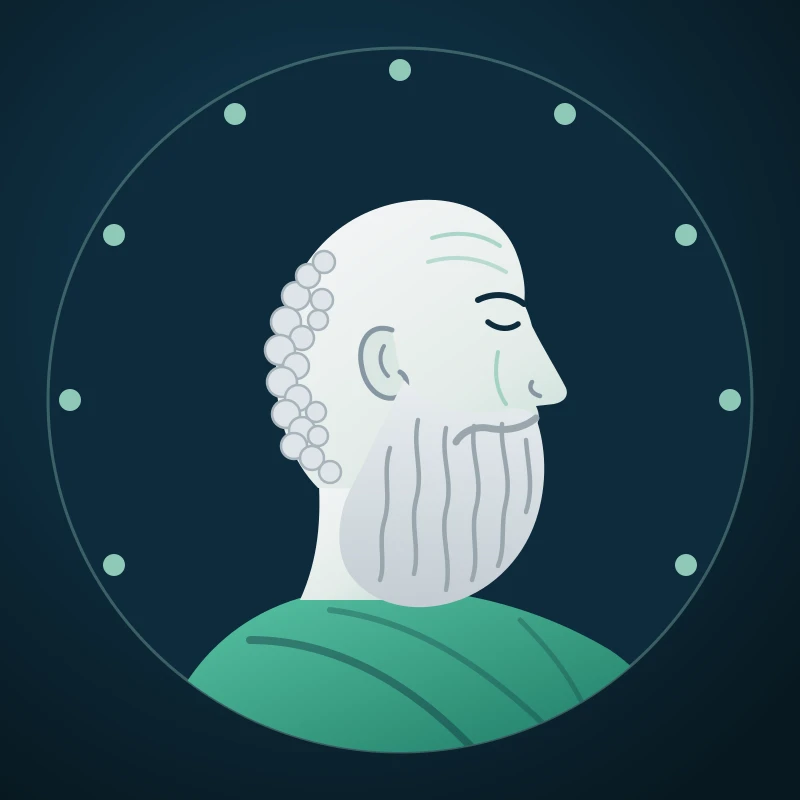
Hippocrates, in profile on the Democura medallion

Speak With Hippocrates

The Physician of the Oath, on the Line.

Talk with Hippocrates, by call or chat, in an AI voice grounded in public-domain translations of the writings that bear his name: the Oath, the Law, the Precepts, the Aphorisms and more. Ask him about the Oath, what a physician owes the patient, or why a doctor keeps a secret.

Speak With Hippocrates

Not Hippocrates, and not medical advice. He names the work when he quotes his writings.

Health, and the People's Right to It

Care of the People.

Not a revolution. An answer to a question healthcare has left underserved for too long: care people can understand and reach, and practices that can give it with peace of mind.

Get in Touch

A real person writes back. No list to join, no inbox to flood.